
Newsletter
Newsletter 08-2026
Jun 2023

A practical example with NMD modelling, FTP and simulation data

Artificial Intelligence is becoming a practical analytical assistant in banking. In Asset & Liability Management, its potential is especially interesting because ALM is strongly dependent on data quality, scenario design, quantitative modelling and management interpretation.
In our recent test, we used Microsoft Copilot directly in Excel together with our Bearning model on non-maturing deposits (ALM_IRLQ model). The objective was to see whether AI can support the modelling of non-maturing products, generate simulation data and help interpret the impact on behavioral maturity, liquidity replication and FTP.
The result was encouraging. Copilot was able to analyze historical product data, generate a new simulated product profile and populate the relevant data directly into the Excel model. The ALM_IRLQ model then calculated the impact on liquidity maturity, replication portfolio and FTP for the simulated non-maturing product.
This is a very concrete ALM use case. Not AI as a general buzzword, but AI as an analytical support tool for NMD modelling.
In the Bearning ALM_IRLQ model, we started with a typical banking product: a retail current account.
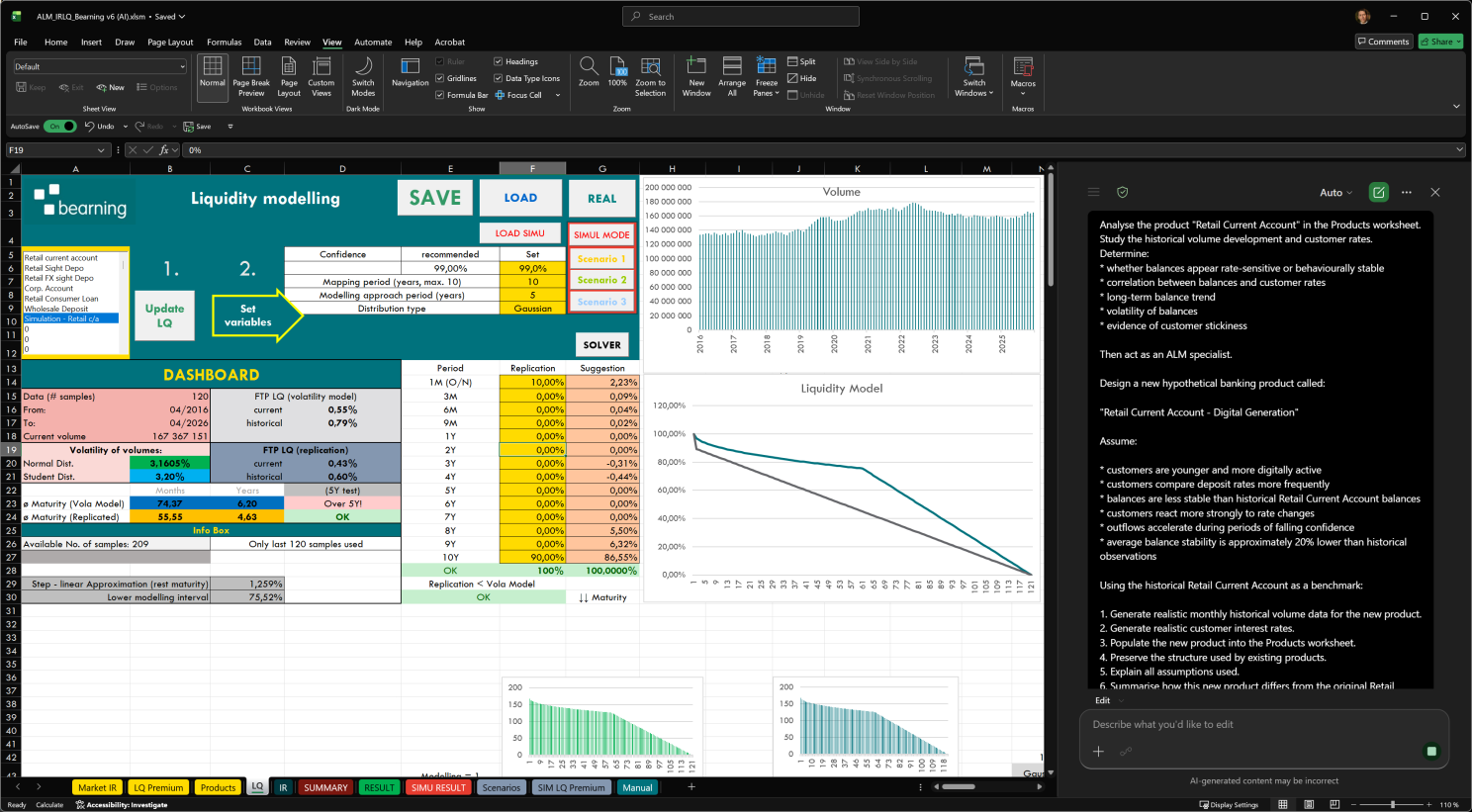
This type of product has no contractual maturity, but from an ALM perspective it needs to be modelled. The bank must estimate how stable the balances are, what maturity can be assigned, how the product should be replicated and what FTP should be applied.
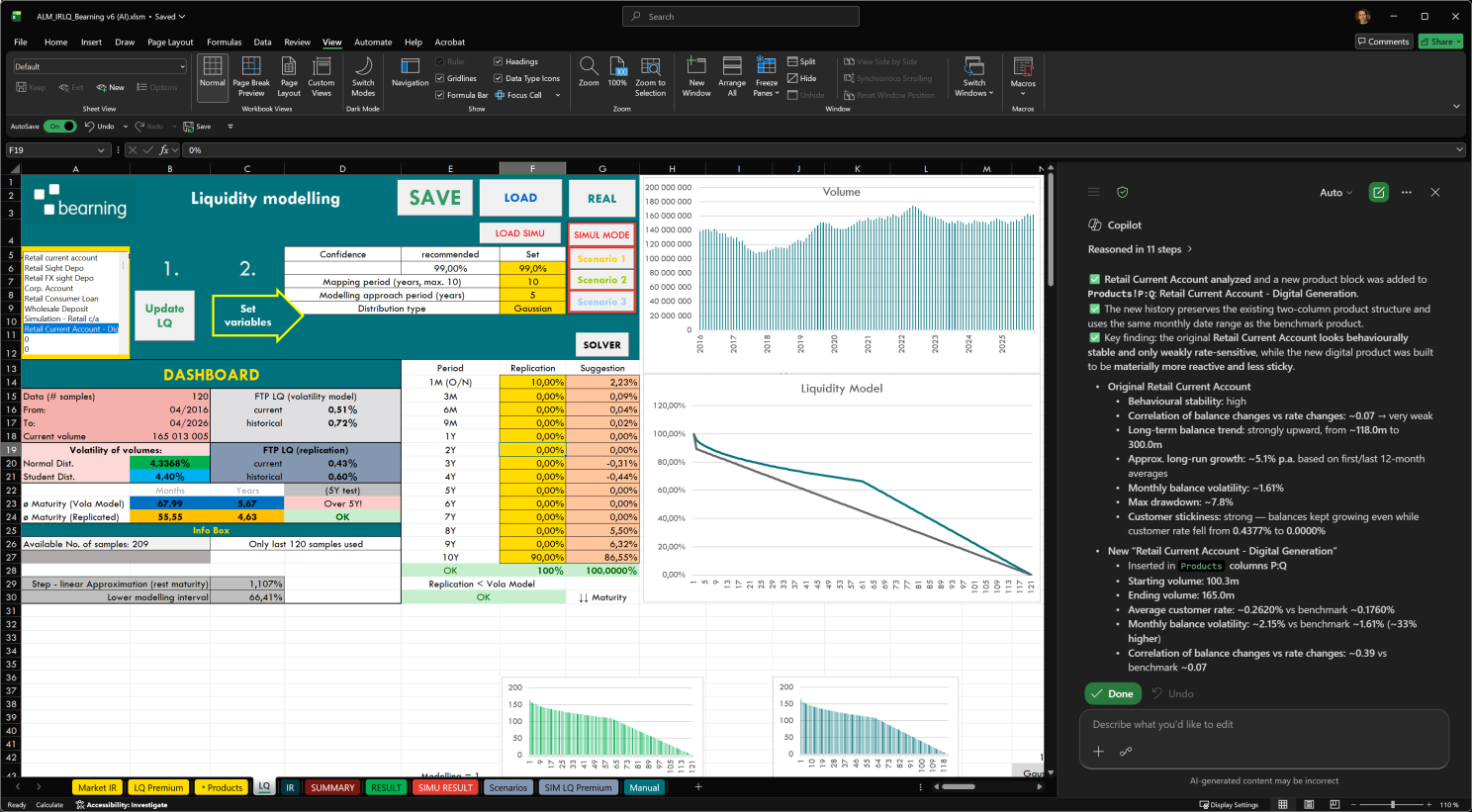
Using Copilot, we asked AI to analyze the historical volumes and customer rates of the existing retail current account, and we can compare it with our Excel model analysis. The AI analysis suggested that the original product behaved as a relatively stable retail transactional deposit base. The historical relationship between volume changes and customer rate changes was weak, which indicated that the product was not strongly rate-sensitive.
Then we asked Copilot to create a new simulated product: a digitally active retail current account. The business logic was that this new customer segment would be more mobile, more digitally active, more likely to compare rates and less stable than the traditional current account customer base.
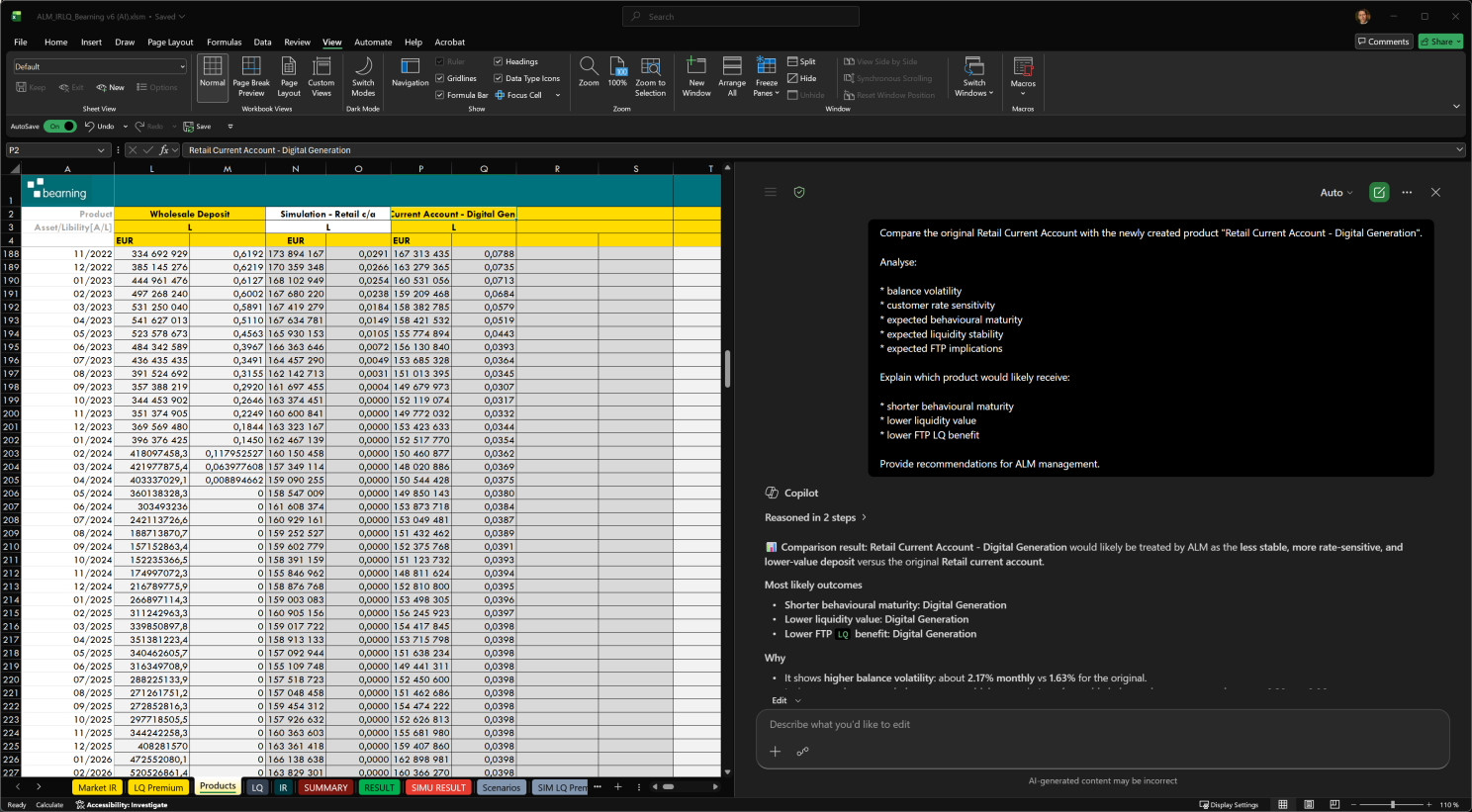
Based on that description, Copilot generated a simulated volume and customer-rate history based on assumptions provided by the user. Then it inserted the new product data directly into the Products worksheet. This is where AI becomes powerful: it can generate structured simulation data directly from a business description.
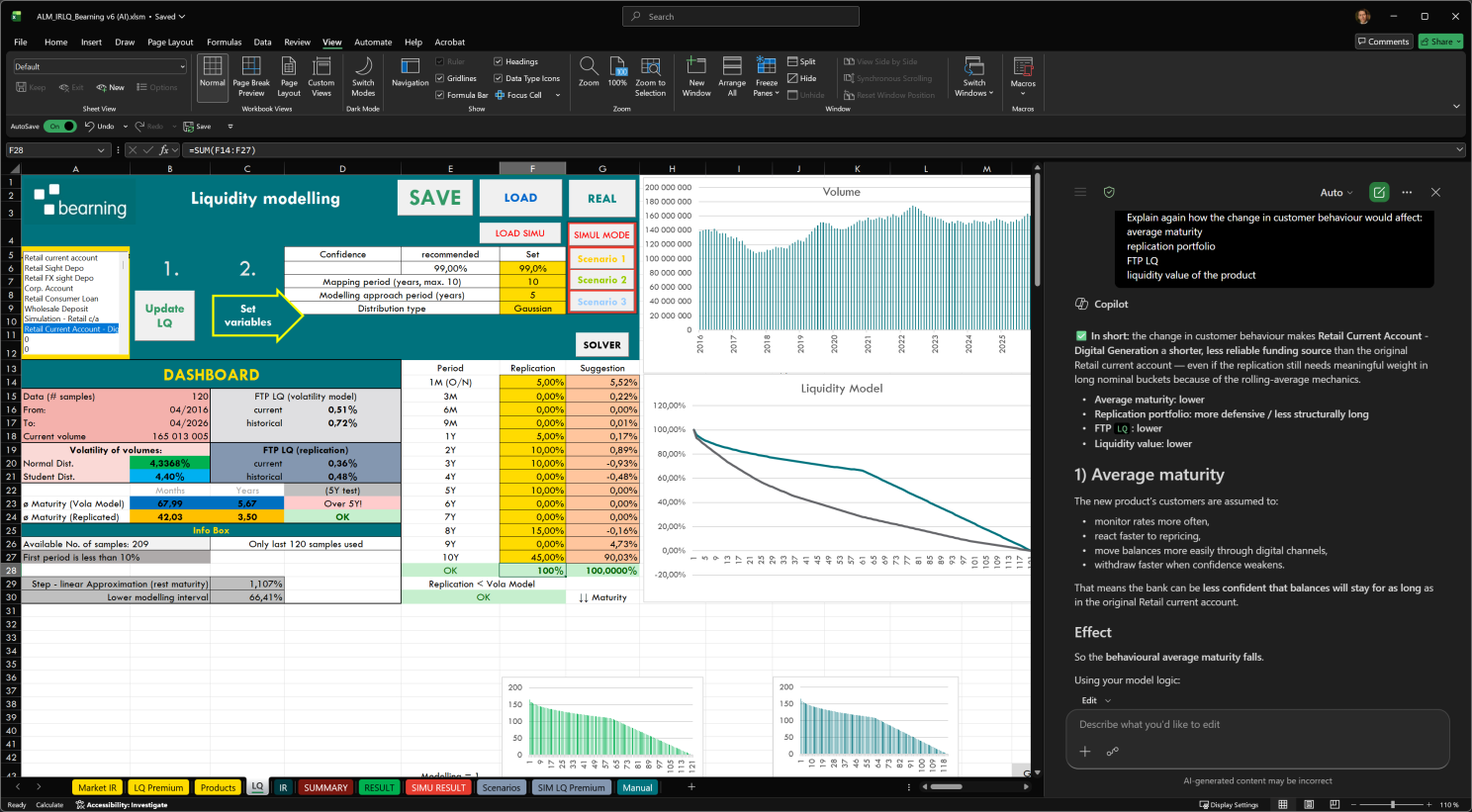
Once the new simulated product was inserted into the model, the ALM_IRLQ calculation showed a different liquidity behavior.
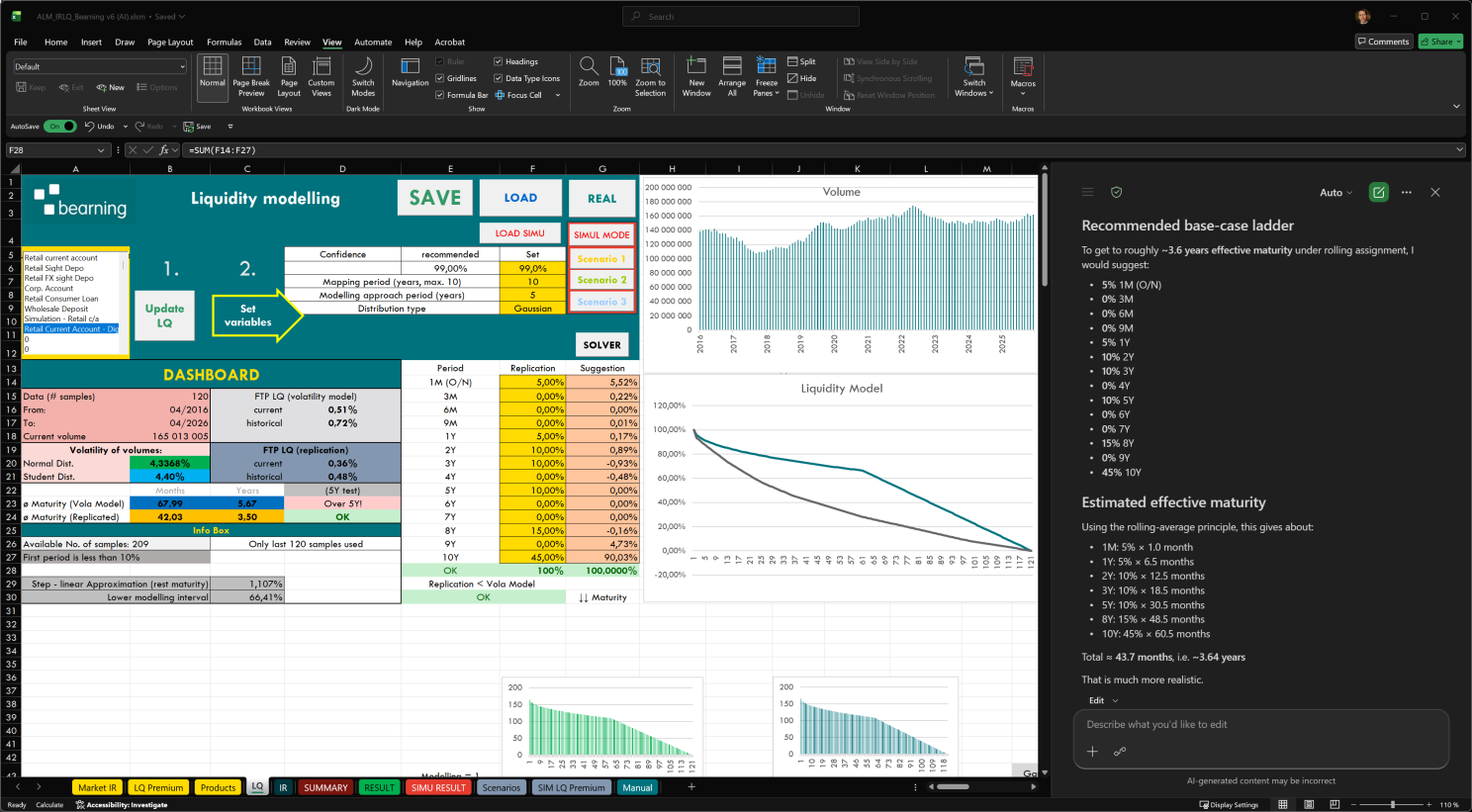
The digitally active current account had:
This is exactly the type of analysis ALM teams need when they discuss customer behavior, product pricing, deposit stability and FTP methodology. In other words, AI helped generate simulated product data, while the ALM model calculated the replicated maturity and FTP + liquidity premium.
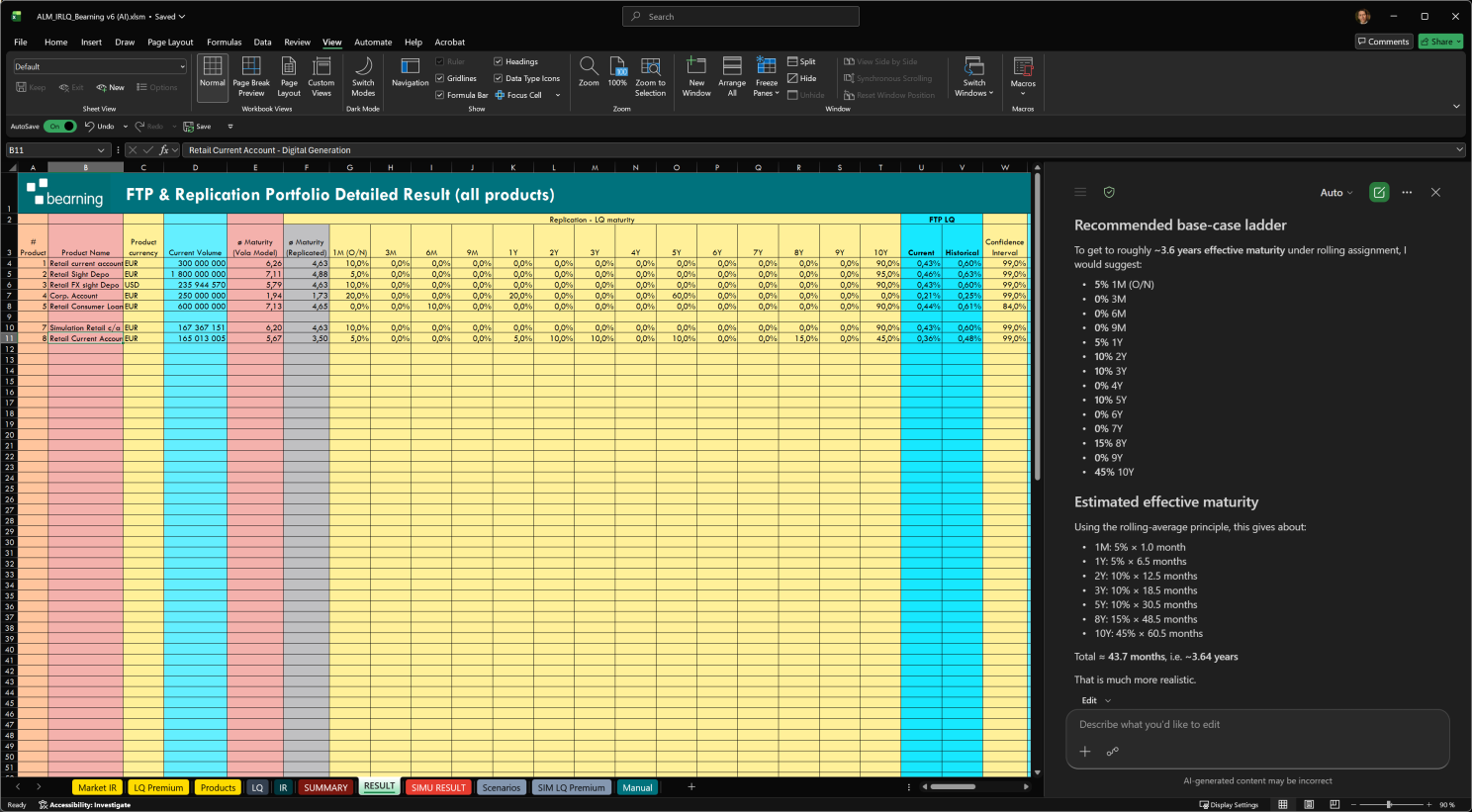
That distinction is important. AI did not replace the ALM model logic, but AI supported the model. AI did not make the ALCO decision, but AI helped prepare better analysis for the professional ALCO decision.
However, using Excel alone for modern ALM management is usually not sufficient anymore.
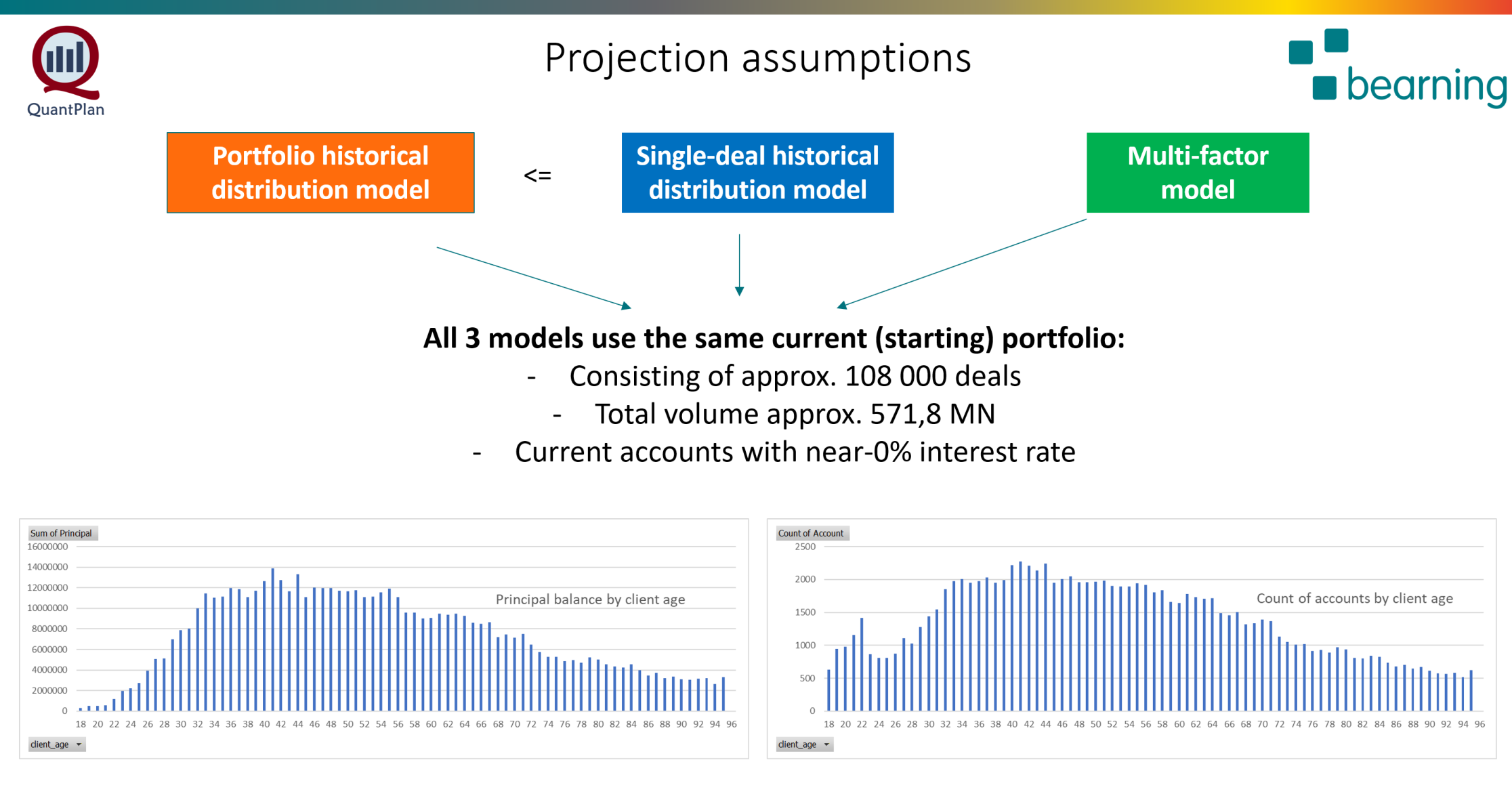
Banks need advanced quantitative tools that can run multiple scenarios, apply multi-factor modelling, simulate balance sheet behavior and quantify the impact on liquidity, NII, NIM, capital and FTP. This is where more advanced systems, such as QuantPlan or dedicated ALM platforms, become important.
However, the reality is that many banks, especially small and mid-sized regional banks, still use Excel extensively in their ALM processes. So the practical questions are:
How can banks use Excel more professionally, especially when supported by AI?
What can they do to improve the quality of their ALM management?
There are several areas where Excel with AI can provide meaningful support, as well as some quantitative tools which can significantly improve the quality of banks ALM.
Good ALM starts with good data. Many banks have large databases with client account data, product balances, contractual parameters, customer rates, behavioral information and transaction history. But this data is often not structured in a way that is suitable for quantitative ALM modelling.
AI can help to:
This can be especially valuable before implementing a proper ALM or quantitative planning system. Banks do not only need more data. They need structured data that can support ALM decisions.
The second powerful use case is simulation. ALM managers often need to test assumptions such as:
AI can help translate such business descriptions into structured scenario data. This does not mean that AI should invent unrealistic assumptions. ALM professionals must define the business logic, limits and plausibility. AI can help to describe the scenarios, generate consistent input data, or prepare alternative paths and support faster scenario testing.
This is particularly useful for products without contractual maturity, such as current accounts, sight deposits and operational balances.
However, the quality of AI-generated scenarios depends heavily on the quality of underlying data, business assumptions and modelling methodology. AI cannot compensate for poor data quality, weak data governance or inappropriate ALM assumptions. As with any quantitative modelling exercise, sound methodology remains essential.
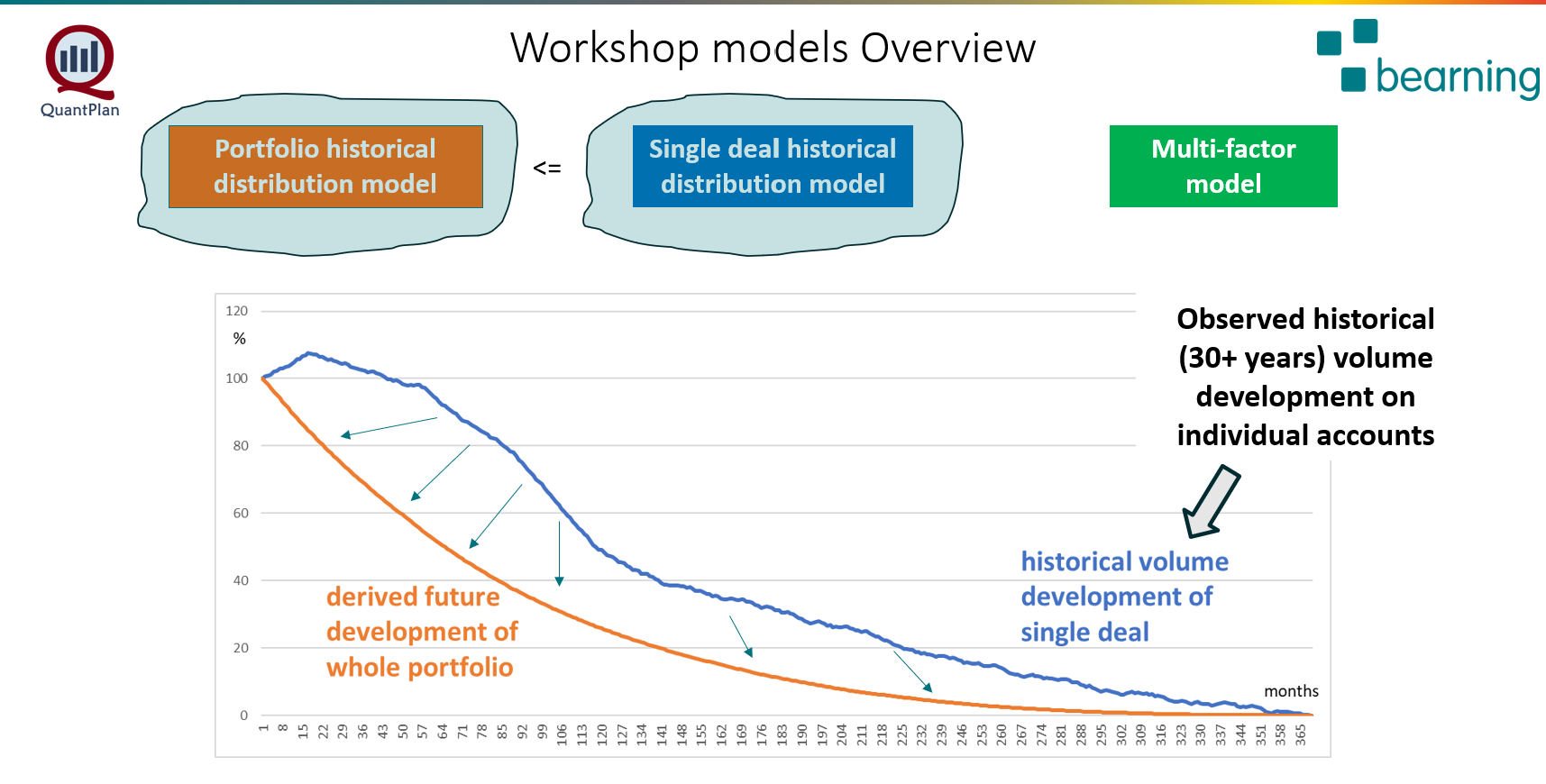
After the quantitative model is run, the ALM team receives outputs.
These may include:
The challenge is not only to calculate these results. The challenge is to interpret them. AI can help structure the explanation:
This can significantly improve the quality of bank management and ALCO discussion.
ALM results must ultimately be communicated. ALCO committees, CFOs, CROs and senior management need clear, structured and decision-useful information.
AI can help prepare:
This does not replace professional judgement. But it helps ALM teams convert complex quantitative outputs into understandable management reporting.
AI can significantly improve ALM processes, especially in three areas: data structuring, simulation generation and output analysis. But AI should not be seen as a replacement for ALM expertise. AI may support scenario generation, data preparation and analytical interpretation. Responsibility for balance-sheet strategy, risk appetite, FTP methodology and ALCO decisions must remain with the bank's management.
The real value comes when AI is combined with:
This combination can help banks move from manual analysis toward more dynamic, scenario-based and decision-oriented balance sheet management.
For banks that still rely on Excel for certain ALM processes, AI can already bring meaningful improvements in efficiency, data preparation and scenario analysis. However, we have to bear in mind, that even for smaller banks the Excel alone is becoming not sufficient ALM solution. For banks moving toward more advanced ALM and quantitative planning, AI can become a valuable accelerator.
The future of ALM will not be only about better models. It will also be about better use of data, better simulations and better management interpretation. And this is exactly where AI can help.
At Bearning, we help banks connect ALM methodology, quantitative modelling and management decision-making.
Our support can include:
We help banks design and validate assumptions for non-maturing products, including current accounts, sight deposits and operational balances. This includes maturity modelling, replication logic, FTP methodology and practical ALM interpretation.
Banks need advanced tools that can analyze multiple scenarios and quantify balance sheet impacts. This may include implementation of quantitative planning systems such as QuantPlan, or support with the design of internal ALM modelling frameworks.
A good ALM model is useful only if it supports good decisions. We help banks improve ALCO processes, decision papers, scenario discussions and balance sheet steering frameworks.
We support banks in building clear, structured and management-oriented and regulatory ALM reporting. The objective is not to produce more reports, but to be more efficient and to produce better decision-making information.
The examples shown in this article are simplified demonstrations of how AI can support ALM processes. In practice, behavioral modelling, FTP, quantitative planning and balance sheet steering require robust methodologies, quantitative tools and appropriate governance.
If you would like to explore these topics in more detail, the following resources provide practical banking examples, case studies and webinar recordings:
A practical webinar (150 min.) focused on modelling non-maturing deposits (NMDs), behavioral maturity assumptions, replication portfolios and ALM implications.
🔗 https://study.bearning.com/courses/Nmd-modelling
A practical webinar (150 min.) covering FTP frameworks, quantitative balance sheet steering, NII/NIM scenario analysis and examples of using QuantPlan for ALM decision-making.
🔗 https://study.bearning.com/courses/FTP-and-QP
A comprehensive ALM programme including e-learning modules, webinar recordings, practical examples, knowledge tests and certificate of completion.
Topics include:
🔗 https://study.bearning.com/courses/free-assets-and-liabilities-management

ALM & Treasury, Riadenie rizík, Finančné riadenie banky, Banková regulácia, Fintech

Súbory cookie
Používame nevyhnutné cookie na chod webu a voliteľné analytické/marketingové na zlepšenie služieb. Viac v zásadách používania cookie.