Newsletter
Newsletter 08-2026
Jun 2023
Rising long-term yields and yield-curve risk, ECB supervisory data, and the BIS report on the future of digital money.

Welcome to the March edition of the Bearning newsletter.
Recent weeks have brought a sharp shift in global financial markets. The geopolitical escalation in the Middle East and disruptions in commodity supply chains—particularly oil flows through the Strait of Hormuz—have quickly translated into higher inflation expectations and a repricing across fixed income markets. For banks, this environment is once again testing the stability of balance sheet management and structural profitability.
In this issue, we focus on what these developments mean for Treasury, ALM, and risk management. We also highlight new data from ECB supervision and discuss recent BIS work on digital money and its regulatory implications.
The recent increase in long-term government bond yields across major markets (US, UK, Eurozone) reflects a combination of factors: renewed inflation concerns driven by commodity shocks, supply-side disruptions, and growing uncertainty about the future path of monetary policy.
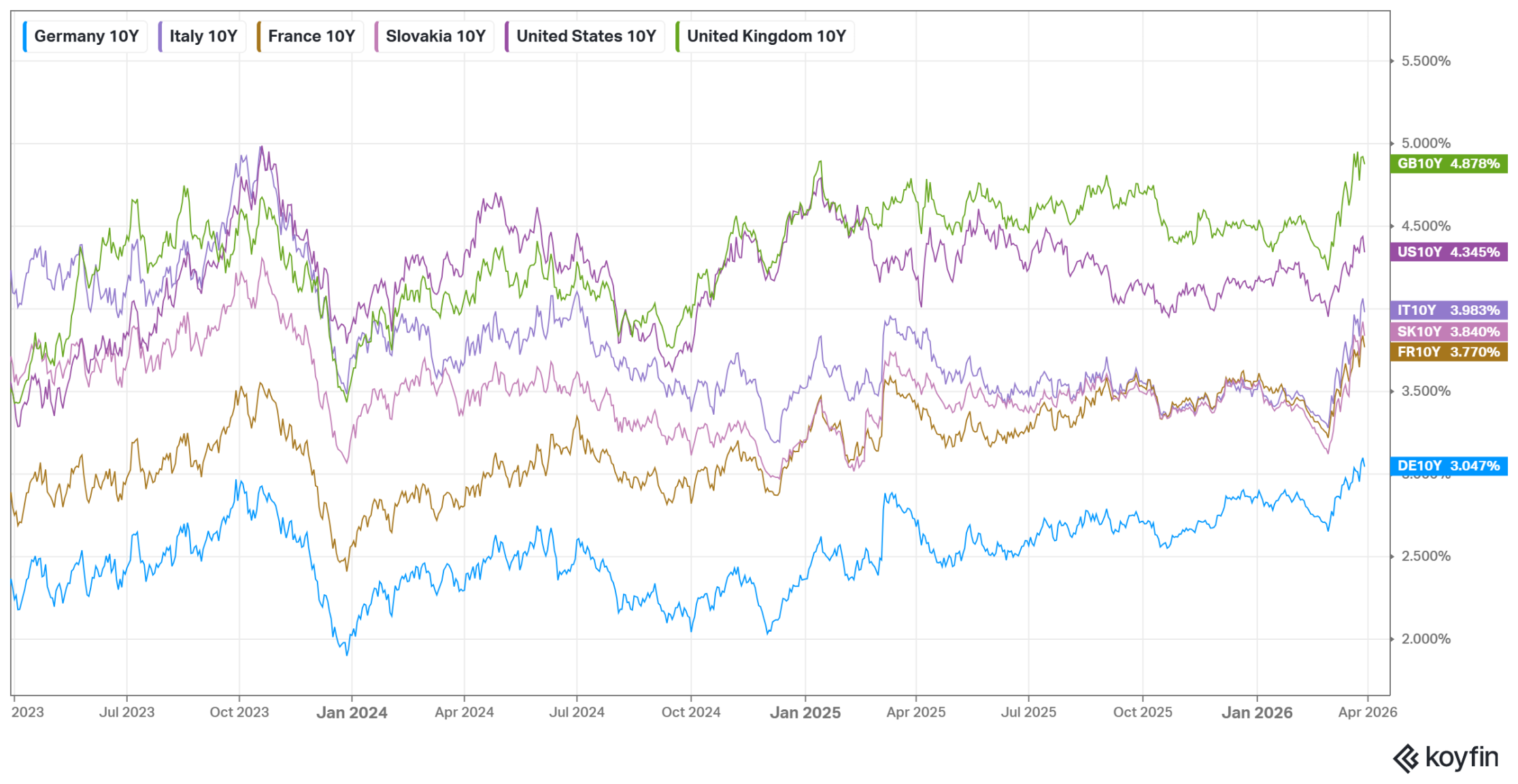
As visible in the market data, 10-year yields have moved significantly higher across jurisdictions, with the UK approaching 5%, the US above 4.3%, and Eurozone benchmarks also rising. This repricing has immediate consequences for banks:
This is particularly challenging for banks' ALCOs, as well as ALM and Treasury teams. The current environment introduces instability. The key issue is not only the level of rates, but their unpredictability.
As we have seen in previous cycles, even relatively small shifts in long-term yields can significantly impact economic value (EVE). This was already highlighted in our earlier discussions on interest rate risk and bond portfolio sensitivity.
Equally important is the development of the yield curve shape. The spread between 10-year and 3-month rates in the US, UK, and Germany has increased markedly in recent weeks, indicating a steepening trend. At the same time, the volatility of this spread has risen sharply.
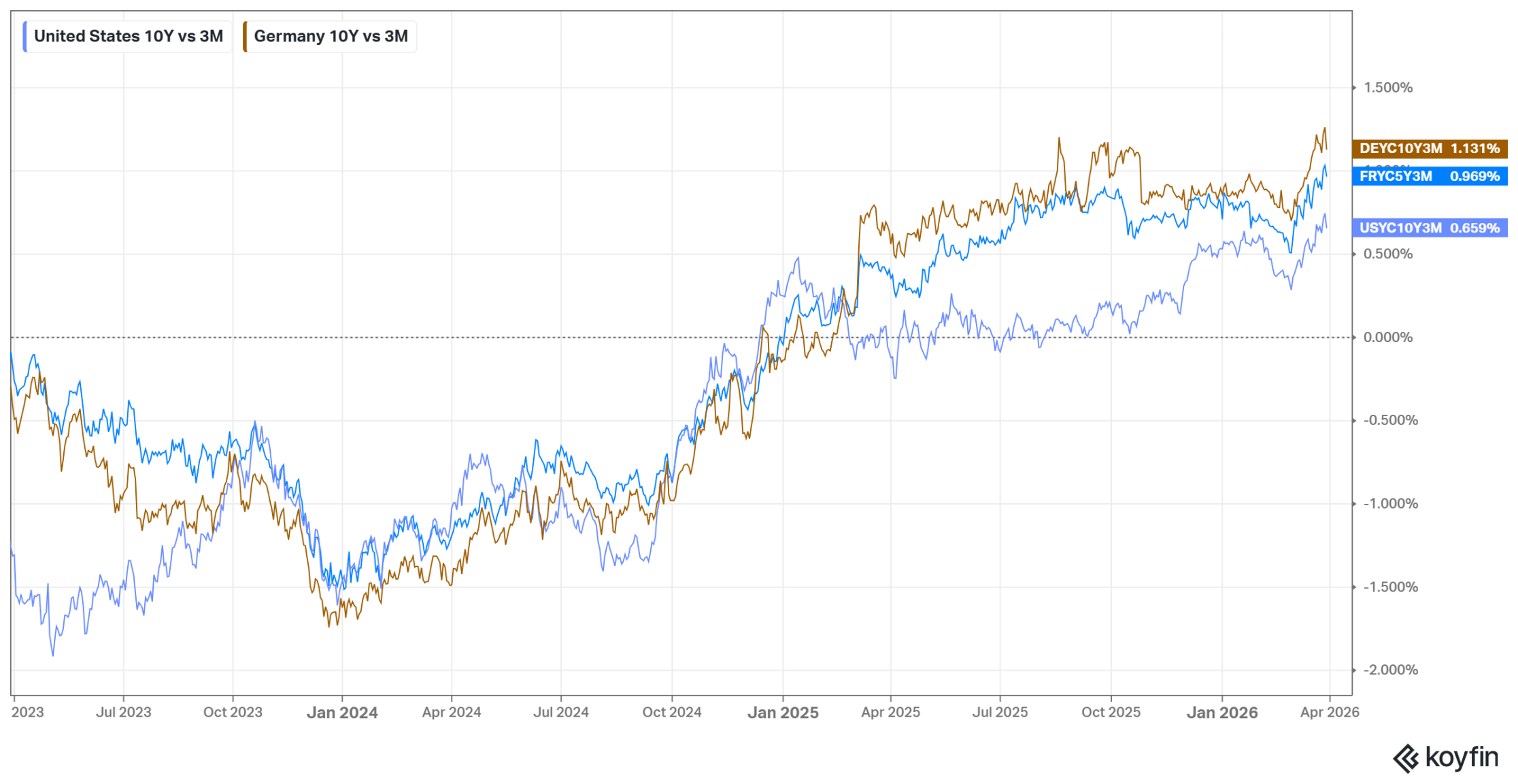
This creates a complex situation:
This tension makes the future shape of the yield curve highly uncertain. For banks, this translates directly into yield curve risk, one of the most important but often underestimated components of IRRBB:
In practice, this means that ALM teams must:
The difficulty is clear: the environment is no longer predictable, and traditional single-scenario planning is no longer sufficient.
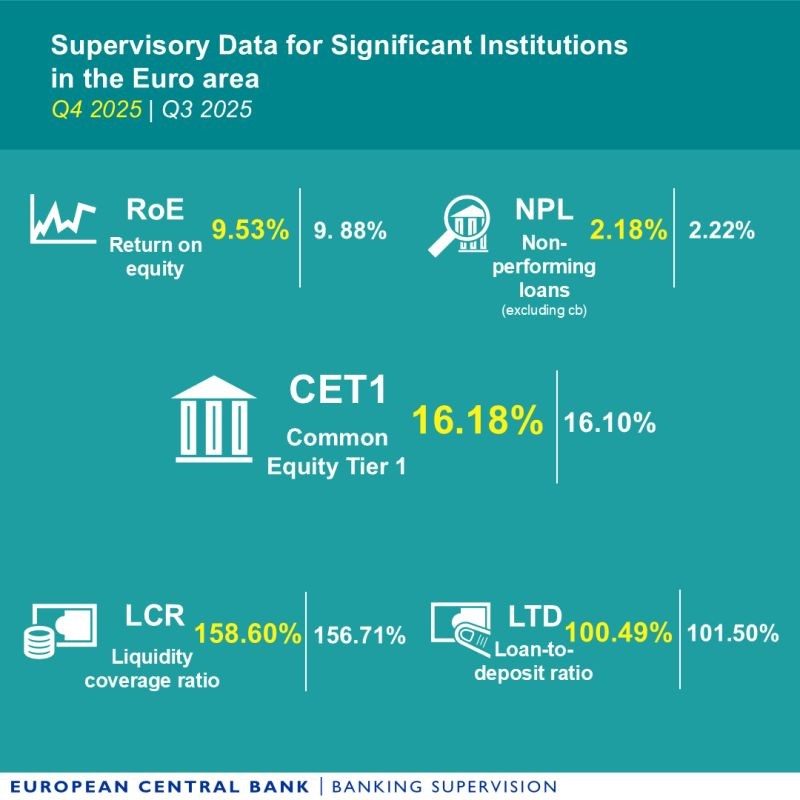
In this context, it is useful to look at the latest ECB supervisory statistics for Q4 2025, which provide a comprehensive overview of the European banking sector. Our LinkedIn commentary is 👉 here.
The data confirms that while banks entered this period with relatively strong capital and liquidity positions, their profitability remains closely linked to interest rate developments. In a volatile yield environment, this dependence becomes a key risk factor.
👉 Full ECB statistics: https://www.bankingsupervision.europa.eu/framework/statistics/html/index.en.html
Another important topic we covered this month is the BIS report on digital money. Read our LinkedIn commentary here.
The report provides a structured view on the coexistence of different forms of money - Central bank money (CBDCs), commercial bank deposits, private digital money (cryptocurrencies including stablecoins). From a banking perspective, the key takeaway is that the structure of money itself is evolving, with implications for:
For Treasury and ALM, this is not a distant topic. Changes in the nature of money directly affect customers' behavior, deposits stability, liquidity buffers, and balance sheet structure - all core elements of modern bank management. 👉 Full BIS paper is available here: https://www.bis.org/publ/bppdf/bispap166.pdf
In March, I had again the opportunity to contribute to the Risk.net Trading Risk Management virtual course, where I delivered three sessions across the programme. This was already the third time participating in this initiative. My sessions focused on practical aspects of trading risk management:
Trading and Market Risk remain the most dynamic areas of bank risk management, especially in today’s volatile market environment. Understanding how trading activities interact with broader ALM and risk frameworks is increasingly important for banking professionals.
In April, we are looking forward to two upcoming webinars focused on key ALM topics:
In the current environment of volatile interest rates and uncertain yield curve development, these topics are becoming even more relevant. Proper FTP setup and realistic modelling of deposit behavior are essential for stable structural profitability, correct internal pricing of products and reliable NII and EVE projections.
These webinars will combine conceptual explanation with practical examples and modelling approaches used in real banking environments, including QuantPlan – a practical tool for ALM and planning.
👉 More details and registration: https://study.bearning.com/bundles/ftp-and-nmd-modelling-webinars-bundle

Our structured e-learning bundles remain available with a 40% discount, providing a comprehensive way to build expertise in core banking areas such as Asset & Liability Management (ALM), Controlling and Funds Transfer Pricing (FTP), Treasury and financial markets or Risk management and regulation. Each bundle includes:
👉 Explore all Bearning bundles here: https://study.bearning.com/collections/bundles and 💡 Use discount code 40BEAR2026 to receive 40% off.
In a market environment where balance sheet management becomes more complex and less predictable, continuous education and practical understanding of ALM tools are essential.
V marci sme v Bearning realizovali viacero odborných kurzov, ktoré sa stretli s veľmi pozitívnym ohlasom účastníkov. Medzi hlavné témy patrili:
Teší nás najmä kvalita spätnej väzby od účastníkov, napríklad:
„Oceňujem štruktúru (najskôr big picture, potom jednotlivé príklady) a odbornosť školiteľa.“
Okrem štandardných kurzov sme realizovali aj individuálny manažérsky tréning Fit & Proper. Potreba, aby top manažéri bánk rozumeli do detailov bankovým rizikám, štruktúre súvahy a regulácii, je dnes čoraz výraznejšia. Byť „Fit & Proper“ v zmysle európskej regulácie už nie je len formálna požiadavka, ale praktická nevyhnutnosť pre kvalifikované rozhodovanie na úrovni vedenia banky.
V najbližšom období pripravujeme viacero verejných kurzov:
👉 Kompletný kalendár kurzov a registrácia: https://bearning.sk/sk/public-workshops-calendar
Test Your Knowledge with Bearning Monthly Banking Quiz ✅❌❔
At the end of March, we delivered our course on Special Types of Bonds, where we covered instruments such as inflation-linked bonds (TIPS), covered bonds, perpetual bonds, structured bonds, and other advanced fixed income products. Here is a question from this course:
❓ If an inflation-linked bons (TIPS) has an adjusted principal of $10,200 and a fixed annual coupon rate of 2%, what will be the semiannual coupon payment?
👉 We will share the correct answer and explanation in the next newsletter.
Review and Learn from Last Month’s Quiz
❓ Which of the following most directly increases a bank’s structural liquidity risk?
✅ Correct answer: B) Large share of uninsured deposits
Structural liquidity risk reflects a bank’s ability to maintain stable funding over time, especially under stress scenarios. One of the key drivers of this risk is the stability and behaviour of deposits. Uninsured deposits - typically corporate or large balances above deposit guarantee limits - tend to be more sensitive to market conditions and confidence. In times of stress, these depositors are more likely to withdraw funds quickly, leading to potential liquidity outflows and funding instability. This was clearly observed during recent banking stress events in 2023 (SVB).
Why not the other options?
A) Higher CET1 ratio: A stronger capital position improves resilience and market confidence. While important for solvency, it does not directly increase liquidity risk. In fact, it often reduces overall risk perception.
C) Higher share of fixed-rate loans: This primarily increases interest rate risk (IRRBB), not liquidity risk. It affects repricing and margin sensitivity rather than funding stability.
D) Lower cost-to-income ratio: This reflects better operational efficiency and profitability. It has no direct negative impact on liquidity risk.
For Treasury and ALM teams, deposit structure matters as much as volume. Understanding the behavioral stability of funding sources, especially uninsured and non-retail deposits, is essential for managing liquidity risk and designing realistic stress scenarios.

ALM & Treasury, Riadenie rizík, Finančné riadenie banky, Banková regulácia, Fintech

Súbory cookie
Používame nevyhnutné cookie na chod webu a voliteľné analytické/marketingové na zlepšenie služieb. Viac v zásadách používania cookie.